Monday, June 26, 2017

2017 Hurricane Season Outlook


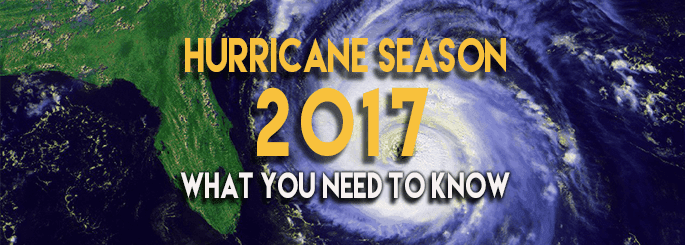
The winds of change may be blowing soon. Once again hurricane season is upon us. What can we expect this year? The 2017 Atlantic hurricane season is forecast to be more active than historical averages regarding the number of named storms and hurricanes, according to a forecast released Thursday by the National Oceanic Atmospheric Administration (NOAA). 

NOAA's forecast calls for a 70 percent likelihood of 11 to 17 named storms (including April's Tropical Storm Arlene). 5 to 9 of those could become hurricanes. Further, 2 to 4 of those might become major hurricanes. The 30-year historical average (1981-2010) for the Atlantic basin is 12 named storms, six hurricanes and three major hurricanes. A major hurricane is one that is Category 3 or stronger on the Saffir-Simpson Hurricane Wind Scale.


“The outlook reflects our expectation of a weak or non-existent El Nino, near- or above-average sea-surface temperatures across the tropical Atlantic Ocean and Caribbean Sea, and average or weaker-than-average vertical wind shear in that same region,” said Gerry Bell, Ph.D., lead seasonal hurricane forecaster with NOAA’s Climate Prediction Center.

Strong El Ninos and wind shear typically suppress development of Atlantic hurricanes, so the prediction for weak conditions points to more hurricane activity this year. Also, warmer sea surface temperatures tend to fuel hurricanes as they move across the ocean. However, the climate models are showing considerable uncertainty, which is reflected in the comparable probabilities for an above-normal and near-normal season.


As usual, all coastal Florida residents are urged to make the same hurricane preparations every year regardless of their prediction. Inspect your property thoroughly. Hire a Certified Arborist to evaluate your trees and provide pruning recommendations to prepare them for hurricane season. Make a comprehensive list of essential items you may need to survive and start now to accumulate them. Locate the nearest hurricane shelter in your area in the event an evacuation order is given. Most importantly, have a plan and be prepared. It only takes one hurricane to make landfall near you and disrupt normal daily activities.


ZIMMERMAN TREE SERVICE LOCATIONS 

ISA Certified Arborist and ASCA Registered Consulting Arborist

Call For an Estimate
Palm Beach County: 561-968-1045
Martin County: 772-546-0811
Boca Raton and Delray Beach: 561-338-3533
Broward County: 954-968-1045
Note: ISA is the International Society of Consulting Arboriculture. ASCA is the American Society of Consulting Arborist.

RECOMMEND ZIMMERMAN TREE SERVICE

Thursday, May 25, 2017

South Florida Lawn And Tree Pest Control


Spring is always a time of new growth. Everything gets more active, and bigger. Unfortunately that includes those freeloaders that like to munch on your greenery. Yes, they are back despite popular demand (that they begone!).Lawn pests can take away your lawn’s beautiful color and overall health if not controlled and treated.

Any signs of munched-on leaves, plants, or fruit could be a sign that the annual bug invasion has begun in your garden. Grass that is turning yellow or reddish-brown in color could be suffering from a chinch bug problem. You might not see them at first. These tiny critters are difficult to spot in the grass during the day.


Some crickets will eat most anything. Mole crickets are one of the most devastating lawn pests all through the Southeast. These insects tunnel through soil and will devour insects and decaying plant matter, along with grass roots and shoots. A lawn infested with mole crickets feels spongy when you walk on it and has irregularly-shaped brown patches. 


All this spring growth will surely get your attention. Spring is the time when homeowners will start to see increasing insect activity outdoors and in. Warmer spring temperatures cause an influx of insects to emerge. Now would be a great time to have a professional come out and treat your trees, shrubs, plants and lawn to prevent any infestations from happening or damage to your greenery. 


Florida is notorious for lawn destroying bugs and keeping them from destroying your yard and plants can seem overwhelming. Your yard should be for you to enjoy, not something you have to fight to keep. When bugs make you want to bug out it is time to call in the pros. At Zimmerman Tree Service we can get rid of them and offer lawn treatments that keep them from coming back.

ZIMMERMAN TREE SERVICE LOCATIONS 

ISA Certified Arborist and ASCA Registered Consulting Arborist

Call For an Estimate
Palm Beach County: 561-968-1045
Martin County: 772-546-0811
Boca Raton and Delray Beach: 561-338-3533
Broward County: 954-968-1045
Note: ISA is the International Society of Consulting Arboriculture. ASCA is the American Society of Consulting Arborist.

RECOMMEND ZIMMERMAN TREE SERVICE

Saturday, April 29, 2017

Mosquito Season And Control In South Florida

Mosquito Treatment and Control in Palm Beach, Broward and Martin Counties


It is getting hotter in Florida and summer is coming. The heat is back, the tourists are back and the insects are back. In Florida with our mild winters it sometimes seems the pests never really go away. At least, not for long. And of all the critters which bug us, the most dreaded just might be those little bloodsuckers the South Florida mosquitoes.


There are 3,500 named species of mosquito, of which only a couple of hundred bite or bother humans. They live on almost every continent and habitat. More than 150 species of mosquito may call your North American backyard home and all are true flies, spending most of their time feeding on plant nectar. Only the females supplement this diet with the blood of animals or birds, which provides the protein necessary for egg maturation. 


Adult females lay eggs on the surface of stagnant water and 4 to 14 days later, the eggs hatch into wriggling larvae that begin to feed on water-dwelling microorganisms including fungi, bacteria, and algae. It is when they grow to adulthood that they begin to feed on us...the females, anyway.


Those female bites can be bad news. When a female mosquito pierces the skin with her proboscis (mouth parts), she injects a small amount of saliva into the wound before drawing blood. Her saliva makes penetration easier and prevents the blood from clotting in the narrow channel of her food canal. The itchy welts that appear after the mosquito leaves is not a reaction to the wound, but an allergic reaction to the saliva injected to prevent clotting. In most cases, the itching sensation and swellings subside within several hours. Some people are highly sensitive and symptoms persist for several days. 


The Palm Beach Daily News recently reported that "State and federal officials said in December that Zika no longer was being actively transmitted in Florida. But public health officials say Zika is likely to return with summer rains." And with another very hot summer almost upon us it is prime time for those feeding and breeding mosquitoes. The Sun-Sentinel eairler this month noted that U.S. Rep. Ted Deutch was quoted "It’s only a matter of time before Florida hits the warm, wet months that will reinvigorate Zika-carrying mosquito populations and put our communities at greater risk.”


Tired of being a snack? A variety of specially-formulated insect repellents are available for sale at camping or sporting goods stores. Apply insect repellent to uncovered skin surfaces when outdoors, especially during the day. When using sunscreen, apply it before insect repellent. As for ridding yourself of mosquitoes, better call in the pros.


Zimmerman Tree Service provides a yard misting mosquito control and treatment designed to reduce the mosquito population around the homeowner’s yard through a two phase attack. The first being an insecticide providing immediate and residual control of mosquitoes and the second is an insect growth regulator which interrupts the reproduction cycle of mosquitoes.


ZIMMERMAN TREE SERVICE LOCATIONS 

ISA Certified Arborist and ASCA Registered Consulting Arborist

Call For an Estimate
Palm Beach County: 561-968-1045
Martin County: 772-546-0811
Boca Raton and Delray Beach: 561-338-3533
Broward County: 954-968-1045
Note: ISA is the International Society of Consulting Arboriculture. ASCA is the American Society of Consulting Arborist.

RECOMMEND ZIMMERMAN TREE SERVICE

Wednesday, March 29, 2017

Lethal Yellowing Treatments In Florida


Lethal yellowing has become a wide-spread problem for palms in Florida. During the last four decades, outbreaks of lethal yellowing disease have killed most of the once prevalent tall-type coconut cultivars in Florida and Jamaica. While coconuts are the most important economic palm affected by this disease, 35 other palm species are susceptible to lethal yellowing.

Lethal yellowing gets its name from the yellowing and drooping of palm fronds beginning with the lower fronds and advancing up through the crown. There is no cure for lethal yellowing although it can be controlled in valuable trees. The good news is that palms native to Florida are generally resistant to this disease.


The lethal yellowing micro-organism is most likely spread by an insect, the planthopper. Research is continuing into the way in which this insect spreads the disease. Tests have demonstrated that insecticides can slow the spread of planthoppers and, with them, lethal yellowing. However, large-scale spraying using currently available chemicals is ecologically damaging and not economically viable. 


The first visible sign that a palm has been infected is the dropping of all of its fruit, irrespective of their size. Over the next two months or so, the new flowers produced by the palm wither and blacken. Then the leaves progressively turn yellow and hang, starting from the lower leaves and finishing with the top leaves. Once the top leaves have gone, the palm is dead and all which is left is something resembling a telephone pole.


The control of lethal yellowing in disease susceptible palms has proven to be very successful, however in order to accomplish this, three things must occur.(1)The proper chemical, oxytetracyclene hydrochloride - (OTC), must be used for the control of lethal yellowing.(2) Injections must be made on a timely basis. Four times per year depending on the degree of current infection or future protection desired.(3)The injections must be applied by a trained technician using the proper syringe and receptacle.

For more information on protecting your palm trees against lethal yellowing, call Michael Zimmerman, Certified Arborist, at (561) 968-1045.

ZIMMERMAN TREE SERVICE LOCATIONS 

ISA Certified Arborist and ASCA Registered Consulting Arborist

Call For an Estimate
Palm Beach County: 561-968-1045
Martin County: 772-546-0811
Boca Raton and Delray Beach: 561-338-3533
Broward County: 954-968-1045
Note: ISA is the International Society of Consulting Arboriculture. ASCA is the American Society of Consulting Arborist.